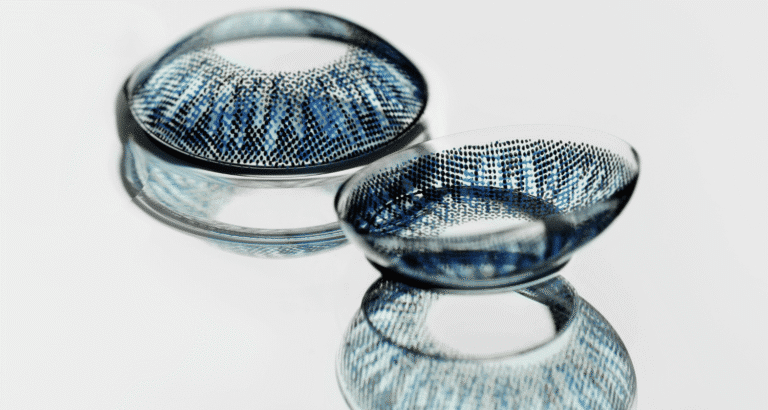

Most people over 40 reach a point where one pair of contact lenses is no longer enough. They can see far just fine but struggle with close-up text. So they start carrying reading glasses everywhere, taking them on and off all day long. Multifocal contact lenses fix that problem. They combine multiple prescription strengths into one lens so you can see clearly at every distance without any extra eyewear. Here is how they work and what to expect if you decide to try them.
At Barnes Talero EyeCare, we fit Nashville patients with multifocal contacts and help them find the right lens for their eyes and lifestyle.
What Are Multifocal Contact Lenses?
Multifocal contact lenses are soft or rigid lenses that contain more than one prescription strength in a single lens. Most have zones for near vision, intermediate vision, and distance vision.
Think of them as the contact lens version of progressive eyeglasses. Instead of switching between reading glasses and regular contacts throughout the day, you wear one pair that handles everything.
The most common patients who benefit from multifocal contacts are people with presbyopia. As the American Academy of Ophthalmology explains, presbyopia contacts are designed to correct the normal vision problems people develop after age 40, when focusing on close objects becomes harder.
How Do Multifocal Contact Lenses Work?
Unlike glasses, contact lenses move with your eye. You cannot look through a different part of the lens by tilting your head like you can with glasses. So how does one small lens handle multiple distances at once?
Multifocal contacts work with how your pupils naturally behave. Your pupils get slightly larger when looking at something far away. They get smaller when reading or looking at something close up. The different zones of the lens align with these small pupil changes, allowing your eye to focus on whatever you are looking at in that moment.
Over time, your brain learns to automatically select the right zone without you having to think about it.
Types of Multifocal Contact Lenses
There are three main designs used in multifocal contacts. Each works a little differently.
Concentric Multifocal Lenses
These lenses have rings arranged in circles from the center outward, like a target. Each ring alternates between a near and a distance prescription. The center is usually set for distance, with rings of near and distance correction spreading outward from there.
Aspheric Multifocal Lenses
These work similarly to progressive eyeglasses. The prescription changes gradually from the center of the lens to the outer edge. There is no sharp boundary between zones. Your eyes learn to use whichever part of the lens they need at any given moment.
Segmented Bifocal Lenses
These are usually rigid gas permeable lenses. The bottom part of the lens corrects near vision and the top corrects distance vision, similar to how bifocal glasses work. The flat bottom edge helps the lens stay in position in your eye.

Multifocal vs Bifocal Contact Lenses: What Is the Difference?
Both types correct more than one distance, but they work differently.
Bifocal contacts have two distinct zones with a clear boundary between them, one for near and one for distance. Multifocal contacts have a gradual transition between zones, making the shift from near to far vision smoother and more natural.
We offer both bifocal and multifocal contact lenses at Barnes Talero EyeCare and can help you understand which design suits your vision best.
Who Should Consider Multifocal Contacts?
Multifocal contacts work well for people who need correction for more than one distance but do not want to wear reading glasses alongside their contacts. They are most commonly recommended for people with presbyopia, which typically starts between ages 40 and 50.
They can also be an option for people with certain prescriptions that require correction at multiple distances. As Healthline notes in their guide to bifocal and multifocal contact lenses, these lenses are available in daily disposable and extended wear formats, making them flexible for different lifestyles.
If you wear toric contact lenses for astigmatism, ask your eye doctor if multifocal toric options are available for your prescription. Some brands do offer multifocal lenses for people with astigmatism.
Advantages of Multifocal Contact Lenses
Clear vision at all distances. You get correction for near, intermediate, and far vision in one lens. No switching between glasses and contacts throughout the day.
No need for reading glasses. For many wearers, multifocal contacts reduce or remove the need to carry reading glasses.
Natural look. Unlike bifocal glasses, there are no visible lines on your lenses. People around you will not be able to tell you are wearing multifocal lenses.
Available in multiple formats. Multifocal lenses come in soft daily, soft monthly, and rigid gas permeable options. That gives you flexibility in choosing a wear schedule that works for your life.
Disadvantages of Multifocal Contact Lenses
Adjustment period. Your brain needs time to get used to multiple zones in one lens. Most people need a few days to a few weeks before vision feels fully comfortable and natural.
Nighttime glare. Some wearers notice halos or glare around lights at night during the adjustment period. This usually improves over time.
Not perfect for everyone. Vision may not be as sharp as single vision contacts for all tasks. Some people find certain activities like detailed close work or driving at night require extra care.
Higher cost. Multifocal lenses cost more than standard single vision contacts because of their complex design.
If you deal with dry eye disease, discuss this with your eye doctor before trying multifocal lenses. Dry eyes can make the adjustment period harder and affect comfort during wear.
Alternatives to Multifocal Contact Lenses
Multifocal contacts are not the only option for people with presbyopia. Other choices include:
Reading glasses with single vision contacts. Simple and affordable. You wear regular contacts for distance and put on readers when you need to see up close.
Monovision contacts. One eye is fitted for distance, the other for near. Your brain learns to combine both signals. Some people adapt well. Others find it uncomfortable.
Bifocal eyeglasses. A reliable option if you prefer glasses over contacts.
Surgery. For some patients, surgical correction may be a long-term option. This is something to discuss directly with your eye doctor.
We also offer gas permeable contact lenses which can be made in multifocal designs for patients who need a rigid lens option.
Getting Fitted for Multifocal Contacts
Fitting multifocal contacts takes more time and precision than fitting single vision lenses. Your eye doctor measures both eyes, considers your dominant eye, and chooses a starting prescription for each zone.
Most patients try a few different options before finding the right lens. A proper contact lens exam is essential. Getting the fit wrong means your vision at one or more distances will not be clear, which is why working with an experienced eye doctor matters.
If you have had difficulty finding contacts that fit well in the past, our hard-to-fit contact lens services are designed for exactly that situation.
Frequently Asked Questions
What are the disadvantages of multifocal contact lenses?
The main downsides are an adjustment period, possible nighttime glare, higher cost, and vision that may not be perfectly sharp for every task. Not every patient adapts well to them.
Is there a trick to wearing multifocal contacts?
Give yourself time. Most people need one to two weeks to adjust. Wear them consistently every day during that period. Let your brain get used to switching between zones naturally. Forcing it does not help
Why can’t I read with multifocal contact lenses?
If reading is blurry, the near zone prescription may need adjustment. The fit or add power may not be right for your eyes. Go back to your eye doctor and let them know. A small change often fixes the problem.
How are multifocal contact lenses supposed to work?
They work by using multiple zones of prescription power in one lens. Your pupils change size depending on what you are looking at, and the lens zones align with those changes to give you clear vision at each distance.
Why do I see blurry with multifocal contacts?
Blurry vision is common in the first week or two as your brain adjusts. If it continues past that, the prescription or lens design may need to be changed. See your eye doctor for a follow-up fitting.
Can you drive at night with multifocal contact lenses?
Most people can, but some notice halos or glare around headlights and street lights, especially early on. This usually improves after the adjustment period. If it persists, let your eye doctor know so they can check the fit and prescription.
Ready to Try Multifocal Contact Lenses?
If you are tired of juggling reading glasses and contacts, multifocal lenses may be the answer. The right fit makes a real difference in how comfortable and effective they feel.
At Barnes Talero EyeCare, we take the time to do a thorough fitting and follow up to make sure your lenses are working as they should. Call us at (615) 485-6251 or book your appointment online to get started.